Linear Algebra
Symmetric positive definite matrix
Recognize positive energy in every direction through quadratic forms, eigenvalues, Cholesky factors, and worked examples.
Definition
A real square matrix $A\in\mathbb R^{n\times n}$ is symmetric positive definite (SPD) when
\[A^T=A,\qquad x^TAx>0\quad\text{for every nonzero }x\in\mathbb R^n.\]Here $A^T$ is the transpose, $x$ is a column vector, and $x^TAx$ is a scalar called a quadratic form. Both symmetry and strict positivity are required. See van de Geijn’s definition.
SPD matrices describe an energy that increases in every direction away from zero. This structure supports unique solutions to linear systems and Cholesky decomposition, a specialized matrix decomposition.
Intuition: every direction costs energy
For a symmetric two-by-two matrix,
\[A=\begin{bmatrix}a&b\\b&c\end{bmatrix},\qquad q(x)=x^TAx=ax_1^2+2bx_1x_2+cx_2^2.\]The diagonal entries penalize individual coordinates; $b$ couples them. Testing $x=(1,0)^T$ and $x=(0,1)^T$ checks only the coordinate axes. A coupled direction can still have zero or negative energy.
Scaling a direction gives $q(tx)=t^2q(x)$. For SPD input, moving farther along any nonzero direction increases the energy. The origin is the unique minimum.
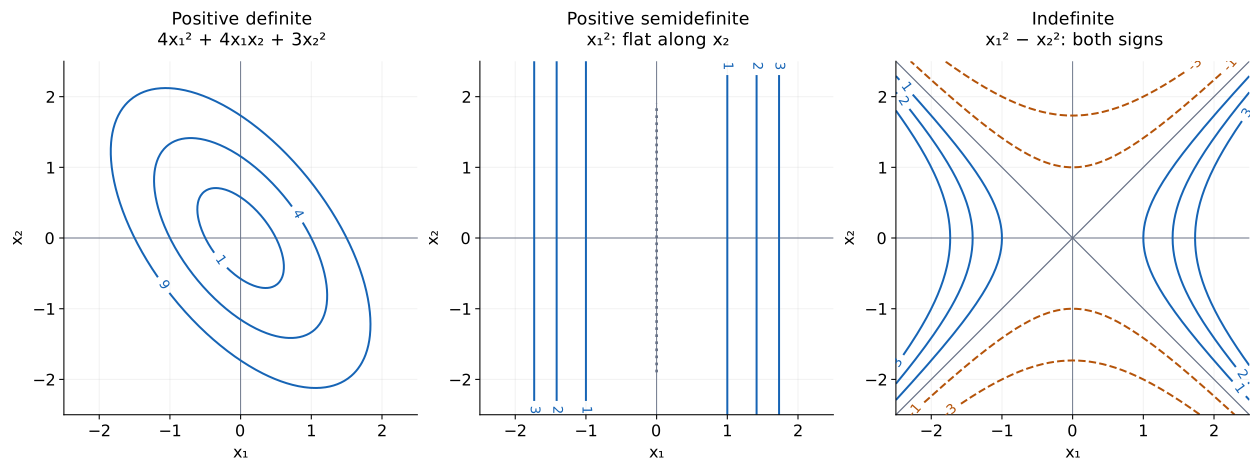
The figure compares the three possibilities. A symmetric matrix is positive semidefinite (PSD) if $q(x)\ge0$ for all $x$, allowing zero energy in nonzero directions. It is indefinite if some directions have positive energy and others have negative energy. See Higham’s definition and semidefinite comparison.
Worked example: prove positivity without checking infinitely many vectors
The following calculations and exercises are original illustrative examples.
Take
\[A=\begin{bmatrix}3&1\\1&2\end{bmatrix}.\]First, matching off-diagonal entries establish symmetry. Next, expand and complete the square:
\[\begin{aligned} x^TAx&=3x_1^2+2x_1x_2+2x_2^2\\ &=3\left(x_1+\frac{x_2}{3}\right)^2+\frac53x_2^2. \end{aligned}\]Each summand is nonnegative. For the sum to vanish, the second term forces $x_2=0$, then the first forces $x_1=0$. Thus every nonzero vector has strictly positive energy.
For $x=(1,-1)^T$, the energy is $3-2+2=3$. This one calculation illustrates the result; the completed-square argument proves it for every direction.
A practical two-by-two test
For $a>0$, the same algebra gives
\[q(x)=a\left(x_1+\frac ba x_2\right)^2+ \left(c-\frac{b^2}{a}\right)x_2^2.\]Therefore a symmetric two-by-two matrix is SPD exactly when
\[a>0,\qquad ac-b^2>0.\]Necessity follows by testing $(1,0)^T$ and $(-b/a,1)^T$; sufficiency follows from the two strictly positive coefficients in the completed square. In the worked example, $a=3$ and $ac-b^2=5$.
Equivalent ways to recognize SPD matrices
For a real symmetric matrix, the following tests are equivalent:
| Test | What to check |
|---|---|
| Quadratic form | $x^TAx>0$ for every nonzero $x$ |
| Eigenvalues | Every eigenvalue is strictly positive |
| Sylvester’s criterion | Every leading principal minor is strictly positive |
| Cholesky factor | $A=LL^T$ with $L$ lower triangular and positive diagonal |
A leading principal minor is the determinant of the upper-left $k\times k$ block, for $k=1,\ldots,n$. See Higham’s equivalent conditions and van de Geijn’s Cholesky theorem. These statements assume symmetry; eigenvalue positivity alone does not establish SPD for a general matrix.
Why eigenvalues explain the geometry
Write the symmetric eigendecomposition as $A=Q\Lambda Q^T$, with orthogonal $Q$ and diagonal $\Lambda$. Put $y=Q^Tx$. Then
\[x^TAx=y^T\Lambda y=\sum_{i=1}^n\lambda_i y_i^2.\]If every $\lambda_i>0$, this sum is positive for nonzero $y$. Conversely, an eigenvector $v_i$ satisfies $v_i^TAv_i=\lambda_i\lVert v_i\rVert_2^2$, so SPD forces $\lambda_i>0$. This derives the eigenvalue test above.
In eigenvector coordinates, the contour $q(x)=1$ has semiaxis lengths $1/\sqrt{\lambda_i}$. A small eigenvalue means a long axis and a direction with weak resistance. For our worked example,
\[\lambda_\pm=\frac{5\pm\sqrt5}{2}>0.\]Why a Cholesky factor is a certificate
For $A=LL^T$ with invertible $L$,
\[x^TAx=\lVert L^Tx\rVert_2^2>0\qquad(x\ne0).\]Our example has
\[L=\begin{bmatrix}\sqrt3&0\\1/\sqrt3&\sqrt{5/3}\end{bmatrix}.\]Multiplying $LL^T$ gives diagonal entries $3$ and $1/3+5/3=2$, and off-diagonal entries $1$. See the Cholesky page for the construction and triangular solves.
Counterexamples to common shortcuts
Positive entries do not imply SPD. The symmetric matrix
\[\begin{bmatrix}1&3\\3&1\end{bmatrix}\]has positive entries, but $q((1,-1)^T)=-4$.
Negative off-diagonal entries are allowed. For
\[A=\begin{bmatrix}3&-1\\-1&3\end{bmatrix},\qquad q(x)=2x_1^2+2x_2^2+(x_1-x_2)^2,\]the energy is strictly positive for every nonzero vector.
A positive determinant is insufficient. The matrix $-I_2$ has determinant $1$, but $q(x)=-\lVert x\rVert_2^2$. Sylvester’s criterion also checks the first leading minor, which is $-1$.
A positive diagonal is insufficient. The positive-entry counterexample has positive diagonal entries but negative energy along $(1,-1)^T$.
Strict positivity of the quadratic form does not imply symmetry. Let
\[B=\begin{bmatrix}1&2\\-2&1\end{bmatrix}.\]Then $x^TBx=x_1^2+x_2^2>0$ for nonzero $x$, but $B^T\ne B$. The skew-symmetric terms cancel in the quadratic form. This is why the definition explicitly includes symmetry.
Where SPD matrices come from
Independent columns and least squares
For a real rectangular matrix $B$,
\[A=B^TB,\qquad x^TAx=\lVert Bx\rVert_2^2.\]This is always symmetric PSD. It is SPD exactly when $B$ has linearly independent columns: then $Bx=0$ forces $x=0$. See van de Geijn’s Gram-matrix exercise. This explains the rank condition on the normal equations discussed in LU decomposition.
For example,
\[B=\begin{bmatrix}1&0\\0&1\\1&1\end{bmatrix},\qquad B^TB=\begin{bmatrix}2&1\\1&2\end{bmatrix}.\]Its first two rows already force any vector in the nullspace to vanish. If both columns instead equal $(1,0,1)^T$, the Gram matrix becomes
\[\begin{bmatrix}2&2\\2&2\end{bmatrix},\]and $(1,-1)^T$ has zero energy. Dependence creates a flat direction.
Quadratic minimization
Consider $f(x)=\frac12x^TAx-r^Tx$ with symmetric $A$. Its gradient is $Ax-r$. If $A$ is SPD, it is invertible: $Ax=0$ would imply $x^TAx=0$, hence $x=0$.
Let $x_$ solve $Ax_=r$. Expanding around this point yields
\[f(x_*+h)-f(x_*)=\frac12h^TAh.\]The difference is strictly positive for nonzero $h$, proving that $x_$ is the unique global minimum. For the worked-example matrix and $r=(4,3)^T$, $x_=(1,1)^T$ and $f(x_*)=-7/2$. SPD turns stationarity into a unique optimum.
Adding a positive penalty
If $C$ is symmetric PSD and $\alpha>0$, then
\[x^T(C+\alpha I)x=x^TCx+\alpha\lVert x\rVert_2^2>0\quad(x\ne0).\]Thus $C+\alpha I$ is SPD even when $C$ has a flat direction. This derivation explains why a positive squared-length penalty removes the nullspace of a least-squares quadratic.
Numerical recognition
In software, establish symmetry and then attempt Cholesky. LAPACK’s DPOTRF reports successful factorization with INFO = 0 and a failed positive-definiteness test with INFO > 0. It reads only the selected triangle, so success does not independently verify that both stored triangles agree.
An SPD matrix can be close to singular. For $A_\varepsilon=\operatorname{diag}(1,\varepsilon)$ with $\varepsilon>0$, the second equation in $A_\varepsilon x=r$ gives $x_2=r_2/\varepsilon$. A change $\delta$ in $r_2$ changes $x_2$ by $\delta/\varepsilon$. Strict positivity guarantees a unique solution, but a very small positive eigenvalue can make it sensitive. Floating-point Cholesky can break down for nearly singular input; see Higham’s numerical discussion.
Interactive example: change the coupling
| Use the existing quadratic-energy lab below for $A=\begin{bmatrix}a&b\b&c\end{bmatrix}$. It shows energy signs, the unit-energy contour when SPD, and a Cholesky certificate. With $a=4$ and $c=3$, predict the transition at $ | b | =\sqrt{12}$. Increase $b$ through that boundary, then try the displayed zero or negative energy direction. |
Explore positive definiteness in every direction
The controls accept keyboard input. A single positive-energy vector does not prove SPD; compare its energy with the lab’s whole-matrix test. Without JavaScript, the completed-square examples above provide the same criterion and explain its boundary.
Practice problems
1. Hand calculation: find the allowable coupling
For which real $t$ is $A=\begin{bmatrix}2&t\t&8\end{bmatrix}$ SPD?
Hint
Use $a>0$ and $ac-b^2>0$.
Worked solution
The first condition holds. The determinant is $16-t^2$, so SPD holds exactly for $-4<t<4$. At $t=4$, $q(x)=2(x_1+2x_2)^2$ vanishes along $(-2,1)^T$. At $t=-4$, it vanishes along $(2,1)^T$. Beyond either boundary, the determinant is negative and the completed-square remainder is negative.
2. Interpretation: what does a positive sample establish?
For $A=\begin{bmatrix}1&3\3&1\end{bmatrix}$, you measure positive energy along both coordinate axes and $(1,1)^T$. Can you conclude SPD? Choose a decisive next test.
Hint
Try opposite signs in the coordinates.
Worked solution
No. The three sampled energies are $1$, $1$, and $8$. But $(1,-1)^T$ gives energy $-4$, disproving SPD. A single nonpositive nonzero direction refutes the definition; finitely many positive samples generally cannot prove it.
3. Abstract reasoning: change coordinates
Suppose $A$ is SPD and $S$ is an invertible real square matrix. Prove $S^TAS$ is SPD. What can fail if $S$ is singular?
Hint
Compare $x^TS^TASx$ with the energy of $Sx$.
Worked solution
Symmetry follows from $(S^TAS)^T=S^TA^TS=S^TAS$. For nonzero $x$, invertibility gives $Sx\ne0$, so $(Sx)^TA(Sx)>0$. If $S$ is singular, some nonzero $x$ satisfies $Sx=0$, giving zero energy. The result is then PSD, but not SPD.
4. Application: remove ambiguity in a fit
A least-squares model has identical columns and Gram matrix $C=\begin{bmatrix}2&2\2&2\end{bmatrix}$. Why are its parameters ambiguous? Does adding $\frac\alpha2\lVert x\rVert_2^2$ to the objective remove the ambiguity for $\alpha>0$?
Hint
Find a null vector of $C$, then examine $C+\alpha I$.
Worked solution
The vector $(1,-1)^T$ changes the two coefficients oppositely without changing the model’s fitted output. The original quadratic therefore has a flat direction. The penalized Hessian is $C+\alpha I$, and its energy is $2(x_1+x_2)^2+\alpha(x_1^2+x_2^2)>0$ for nonzero $x$. The penalized quadratic has a unique minimizer. Its optimum may differ from an unpenalized fit because the objective has changed.
Further learning
- Higham: What Is a Symmetric Positive Definite Matrix?: compare eigenvalue and principal-minor tests and continue to block matrices.
- van de Geijn: Notes on Cholesky Factorization: follow a constructive proof and algorithm for the triangular factor.
- LAPACK: DPOTRF: understand triangle storage and failure reporting in a numerical implementation.
Related pages
References
- van de Geijn, R. A. (2011). Notes on Cholesky Factorization. University of Texas at Austin. SPD definition, Gram matrices, and the Cholesky theorem.
- Higham, N. J. (2020, July 21). What Is a Symmetric Positive Definite Matrix?. Equivalent positivity criteria and semidefinite comparison.
- LAPACK. DPOTRF routine documentation. Symmetric triangle storage and Cholesky success or failure.
- Higham, N. J. (2020, August 11). What Is a Cholesky Factorization?. Floating-point behavior near singularity.