Linear Algebra
Matrix norms
Measure matrix amplification with induced norms, distinguish spectral and Frobenius norms, and bound errors in linear systems.
Two ways to ask how large a matrix is
A matrix is both an array of numbers and a transformation $x\mapsto Ax$. Its size can therefore mean the combined magnitude of its entries, or the largest amplification it can apply to an input. Frobenius norms answer the first question; induced norms answer the second. The choice matters when measuring an approximation or bounding error.
Read vector norms first: a matrix amplification factor compares the size of an output vector with the size of its input.
Definition and convention
A norm on matrices satisfies the same three axioms as a vector norm: nonnegativity with equality only for the zero matrix, absolute homogeneity, and the triangle inequality. Here $A,B\in\mathbb R^{m\times n}$ have the same shape when added.
Some texts additionally require a matrix norm to be submultiplicative:
\[\lVert AB\rVert\le\lVert A\rVert\lVert B\rVert\]for compatible dimensions. This page distinguishes the norm axioms from this extra property. See Higham’s definition and terminology.
Induced norms: worst-case amplification
Using the same vector $p$-norm for input and output, define
\[\lVert A\rVert_p=\max_{x\ne0}\frac{\lVert Ax\rVert_p}{\lVert x\rVert_p} =\max_{\lVert x\rVert_p=1}\lVert Ax\rVert_p.\]The input has $n$ coordinates and the output has $m$. The two expressions agree because a nonzero input can be divided by its size. These norms are also called operator or subordinate norms. Their formulas are
| Norm | Formula | Interpretation | ||
|---|---|---|---|---|
| Induced $1$ | $\max_j\sum_i | a_{ij} | $ | Largest absolute column sum |
| Induced $\infty$ | $\max_i\sum_j | a_{ij} | $ | Largest absolute row sum |
| Induced $2$ (spectral) | $\sigma_{\max}(A)=\sqrt{\lambda_{\max}(A^TA)}$ | Largest Euclidean stretch |
Here $\sigma_{\max}$ is the largest singular value and $\lambda_{\max}$ the largest eigenvalue of the symmetric PSD matrix $A^TA$. For complex input, replace $A^T$ by the conjugate transpose $A^*$. See Higham’s induced-norm formulas.
Why columns for the 1-norm and rows for infinity?
The remaining derivations, examples, and exercises are original illustrations of the cited definitions.
Write $Ax=\sum_jx_j a_j$, where $a_j$ is column $j$. Then
\[\lVert Ax\rVert_1\le\sum_j|x_j|\lVert a_j\rVert_1 \le\left(\max_j\lVert a_j\rVert_1\right)\lVert x\rVert_1.\]Choose $x=e_j$ for a largest column to attain the bound. For the infinity norm, each output coordinate satisfies
\[|(Ax)_i|\le\sum_j|a_{ij}||x_j| \le\left(\sum_j|a_{ij}|\right)\lVert x\rVert_\infty.\]Choose a row with largest sum and give each input coordinate the sign of that row’s coefficient, choosing $1$ at zero coefficients. This produces an input of infinity norm $1$ that attains the bound. Absolute values prevent cancellation from hiding the worst case.
Frobenius norm: size of the whole array
The Frobenius norm treats all entries as one long vector:
\[\lVert A\rVert_F=\sqrt{\sum_{i,j}|a_{ij}|^2}.\]It is submultiplicative, but for square matrices of size $n>1$ it is not induced by a vector norm: $\lVert I_n\rVert_F=\sqrt n$, while every induced norm gives $\lVert I_n\rVert=1$. See Higham’s Frobenius-norm discussion.
The identity changes no vector’s length, yet has $n$ nonzero entries. This explains why total entry magnitude and maximum amplification are different questions.
Worked example: compute all four norms
Let
\[A=\begin{bmatrix}1&2\\0&2\end{bmatrix}.\]- The absolute column sums are $1$ and $4$, so $\lVert A\rVert_1=4$.
- The absolute row sums are $3$ and $2$, so $\lVert A\rVert_\infty=3$.
- The entry squares sum to $1+4+0+4=9$, so $\lVert A\rVert_F=3$.
- For the spectral norm, form
Its characteristic polynomial is $\lambda^2-9\lambda+4$. Thus
\[\lambda_\pm=\frac{9\pm\sqrt{65}}2,\qquad \lVert A\rVert_2=\sqrt{\frac{9+\sqrt{65}}2}\approx2.92081.\]The $1$-norm is attained at $x=(0,1)^T$, whose output is $(2,2)^T$. The infinity norm is attained at $x=(1,1)^T$, whose output is $(3,2)^T$. For the spectral norm, an eigenvector of $A^TA$ for $\lambda_+$ is $(2,\lambda_+-1)^T$; normalize it in the Euclidean norm to get a maximizing input. Different measuring rules can select different worst-case directions.
Geometry: a unit circle becomes an ellipse
The SVD writes $A=U\Sigma V^T$. Orthogonal factors preserve Euclidean length, while $\Sigma$ scales perpendicular coordinates. The largest scale gives the spectral norm.
For $A=\operatorname{diag}(3,1)$, the unit circle becomes an ellipse with semiaxes $3$ and $1$. The spectral norm is $3$; the Frobenius norm is $\sqrt{10}$, combining both scales.
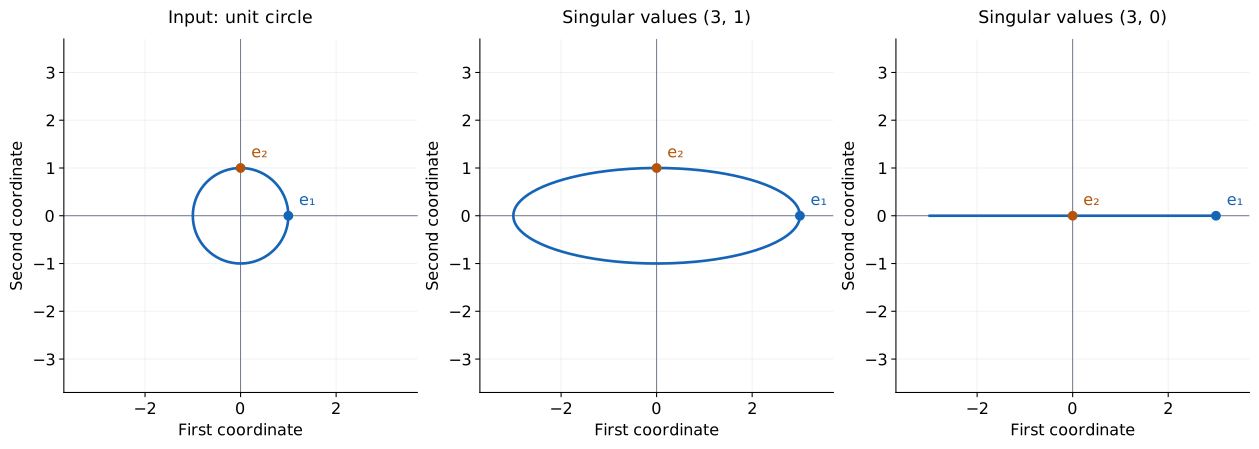
Interactive example: explore directions and matrices
Explore worst-case matrix stretch
Start with the worked-example matrix. Rotate the input direction and compare its amplification with the computed spectral norm. Try a diagonal matrix, the identity, the zero matrix, and [[0,5],[0,0]]. A sampled direction supplies a lower bound, while the exact two-by-two formula computes the maximum. Controls support keyboard input; the static examples above remain useful without JavaScript.
Error bounds and composition
From the induced-norm definition,
\[\lVert A\delta x\rVert_p\le\lVert A\rVert_p\lVert\delta x\rVert_p.\]If the matrix itself changes by $E$, then the output change at a fixed input is $Ex$ and is bounded by $\lVert E\rVert_p\lVert x\rVert_p$. Apply the same inequality twice to get
\[\lVert ABx\rVert_p\le\lVert A\rVert_p\lVert Bx\rVert_p \le\lVert A\rVert_p\lVert B\rVert_p\lVert x\rVert_p.\]Taking the maximum over unit inputs proves submultiplicativity. This explains why norms help bound a sequence of transformations without computing every possible input.
Residual versus solution error
For invertible square $A$, let $Ax=b$, let $\hat x$ be an approximation, and define residual $r=b-A\hat x$. Then
\[x-\hat x=A^{-1}r,\qquad \lVert x-\hat x\rVert_p\le\lVert A^{-1}\rVert_p\lVert r\rVert_p.\]Since $\lVert b\rVert_p\le\lVert A\rVert_p\lVert x\rVert_p$, for nonzero $b$ this yields
\[\frac{\lVert x-\hat x\rVert_p}{\lVert x\rVert_p} \le\kappa_p(A)\frac{\lVert r\rVert_p}{\lVert b\rVert_p},\qquad \kappa_p(A)=\lVert A\rVert_p\lVert A^{-1}\rVert_p.\]The condition number converts a relative residual bound into a relative solution-error bound. LAPACK’s error-measure guide defines conditioning in these norms. In Euclidean geometry, $\kappa_2(A)=\sigma_{\max}/\sigma_{\min}$: reversing a very small stretch magnifies errors. For an SPD matrix, these singular values equal its positive eigenvalues.
For $A=\operatorname{diag}(1,0.001)$, $b=(1,0)^T$, and $\hat x=(1,1)^T$, the exact solution is $(1,0)^T$. The residual has Euclidean size $0.001$, but the solution error has size $1$. Here $\kappa_2(A)=1000$, and the bound is attained.
Common misconceptions and counterexamples
Matrix 1-norm is not the sum of all absolute entries. In the worked example, that sum is $5$ but the induced $1$-norm is $4$. Likewise the induced infinity norm is a row sum, not the largest entry.
| Eigenvalue magnitude is not generally Euclidean stretch. For \(N=\begin{bmatrix}0&5\\0&0\end{bmatrix}\), both eigenvalues are zero, yet $N(0,1)^T=(5,0)^T$ and $\lVert N\rVert_2=5$. Singular values capture this stretch. For real symmetric matrices, orthogonal diagonalization does give $\lVert A\rVert_2=\max_i | \lambda_i | $. |
A norm on entries need not be submultiplicative. Let $J$ be the two-by-two all-ones matrix. Its largest absolute entry is $1$, but every entry of $J^2$ is $2$. Thus the entrywise maximum is a norm on the array but fails the product bound with constant $1$.
A software default may select Frobenius size. In NumPy’s documented conventions, np.linalg.norm(A) for a two-dimensional matrix uses Frobenius size; np.linalg.norm(A, ord=2) uses the spectral norm. State both the array shape and the requested norm.
Practice problems
1. Hand calculation: a rectangular matrix
Find the induced $1$, induced infinity, and Frobenius norms of \(B=\begin{bmatrix}1&-2&0\\3&0&4\end{bmatrix}\). Give an input attaining its $1$-norm.
Hint
List column sums, row sums, and entry squares separately.
Worked solution
Column sums are $4,2,4$, giving $\lVert B\rVert_1=4$. Row sums are $3,7$, giving $\lVert B\rVert_\infty=7$. The squares sum to $1+4+9+16=30$, so $\lVert B\rVert_F=\sqrt{30}$. Either $e_1$ or $e_3$ is a unit $1$-norm input with output $1$-norm $4$.
2. Interpretation: choose the relevant norm
A matrix approximation has error $E$. You want (a) total squared entry error and (b) the largest output error over Euclidean unit inputs. Which quantities answer these questions? Can they coincide?
Hint
Compare the array viewpoint with the transformation viewpoint.
Worked solution
(a) is $\lVert E\rVert_F^2$; (b) is $\lVert E\rVert_2$. These are different objectives. For $E=\operatorname{diag}(1,0)$ both values happen to be $1$; for $E=I_2$ they are $2$ and $1$. Numerical coincidence does not make the definitions interchangeable.
3. Abstract reasoning: why induced identity size is one
Prove that every induced norm gives $\lVert I_n\rVert=1$. Deduce $\kappa(A)\ge1$ for invertible $A$ using the product bound.
Hint
Evaluate the amplification ratio, then use $AA^{-1}=I_n$.
Worked solution
For every nonzero $x$, $\lVert I_nx\rVert/\lVert x\rVert=1$, so the maximum is $1$. Submultiplicativity yields $1=\lVert AA^{-1}\rVert\le\lVert A\rVert\lVert A^{-1}\rVert=\kappa(A)$.
4. Application: propagate bounded input error
For the worked-example matrix $A$, each input coordinate error is at most $0.01$ in magnitude. Bound the largest output coordinate error and exhibit an input error attaining the bound.
Hint
Use the infinity norm and choose signs that reinforce the largest row.
Worked solution
$\lVert\delta x\rVert_\infty\le0.01$ and $\lVert A\rVert_\infty=3$, so $\lVert A\delta x\rVert_\infty\le0.03$. Taking $\delta x=(0.01,0.01)^T$ produces $(0.03,0.02)^T$, attaining the bound. This is a worst-case guarantee, not an assumption about random errors.
Further learning
- Higham: What Is a Matrix Norm?: continue to mixed input/output norms and relationships between matrix norms.
- LAPACK: How to Measure Errors: see norms and condition numbers in numerical error reporting.
- NumPy:
numpy.linalg.norm: distinguish vector, matrix, and entrywise calculations in software.
Related pages
- Vector norms
- Matrix factorization and decomposition
- LU decomposition
- Symmetric positive definite matrix
References
- Higham, N. J. (2021, October 12). What Is a Matrix Norm?. Matrix norm axioms, induced norms, and Frobenius norms.
- Anderson, E., et al. (1999). LAPACK Users’ Guide, third edition. How to Measure Errors. Norm-based error and condition numbers.
- NumPy developers. numpy.linalg.norm. Matrix-norm formulas and software defaults.